




Turkish Marbling Workshop – Ebru Lessons in Istanbul
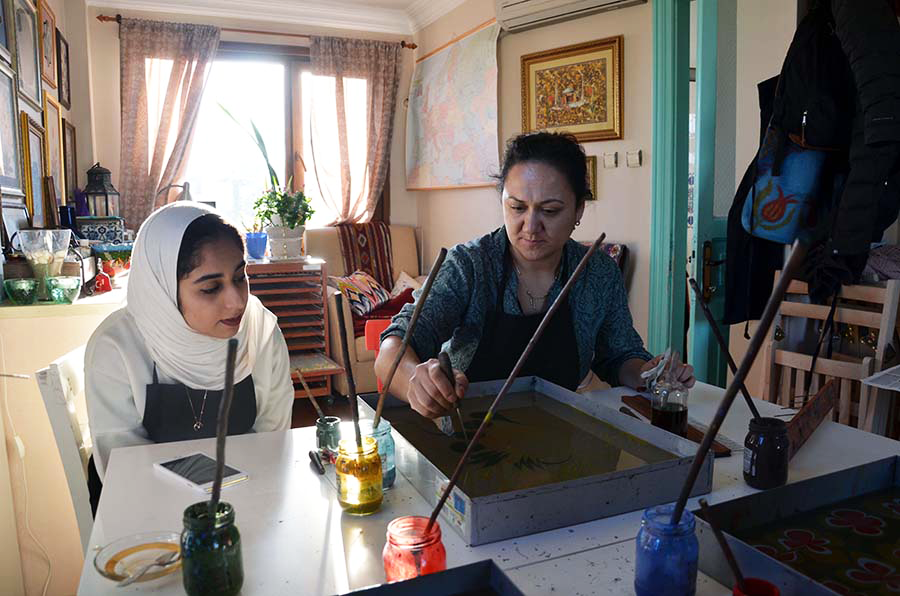
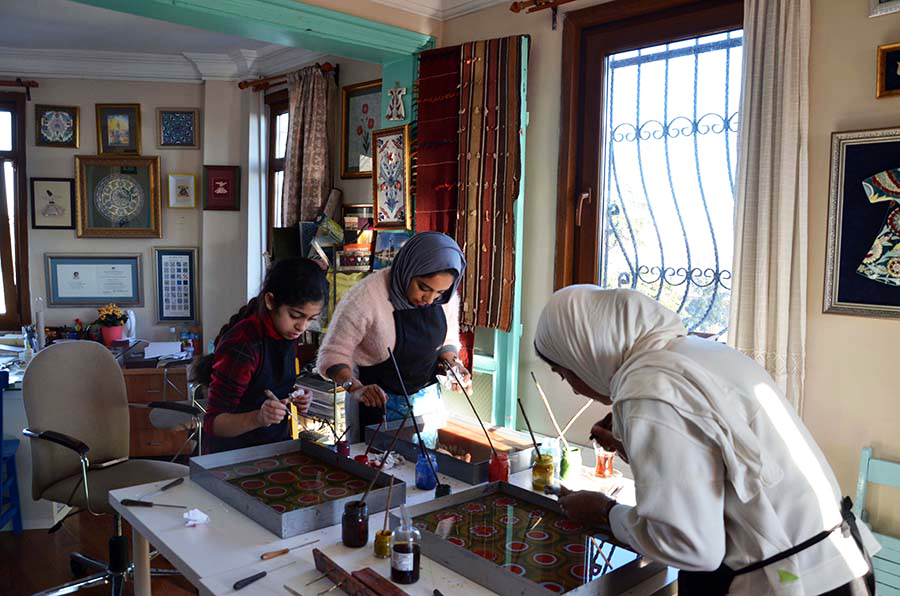
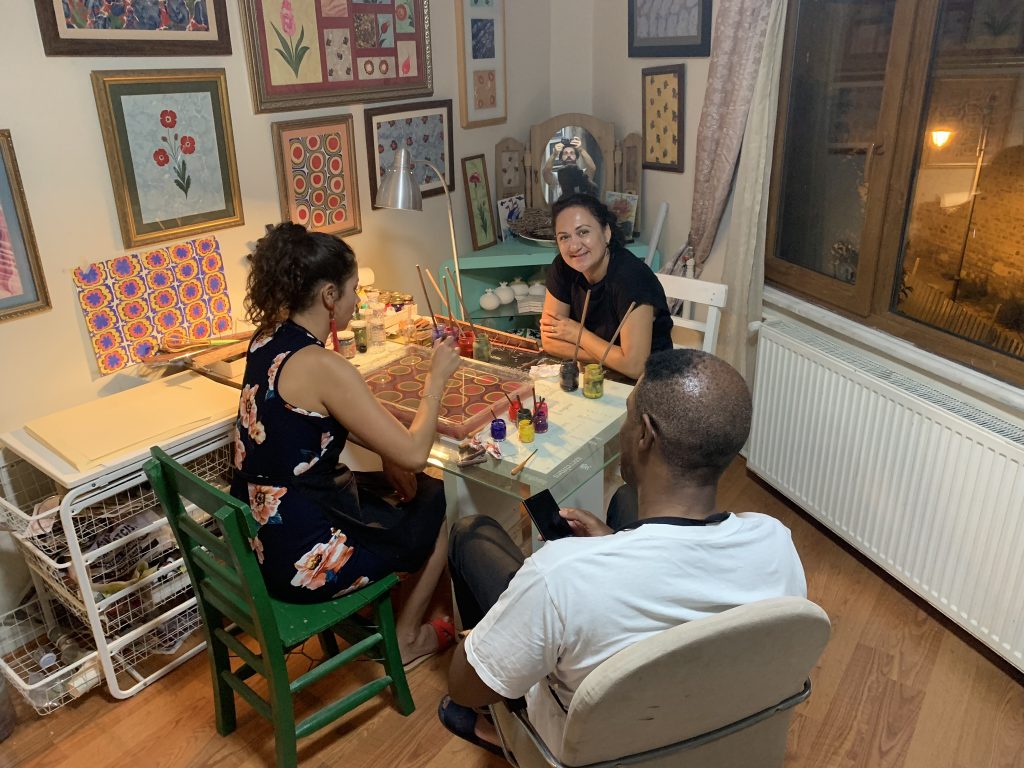
Turkish Paper marbling is a method of aqueous surface design, which can produce patterns similar to marble or other stone, hence the name. The patterns are the result of color floated on either plain water or a viscous solution known as size, and then carefully transferred to a sheet of paper (or other surfaces such as fabric). In Ebru art, you can draw flower figures that are traditional from the Ottoman period BUT the things that you can capable of using Ebru art is unlimited. All you need is your imagination.
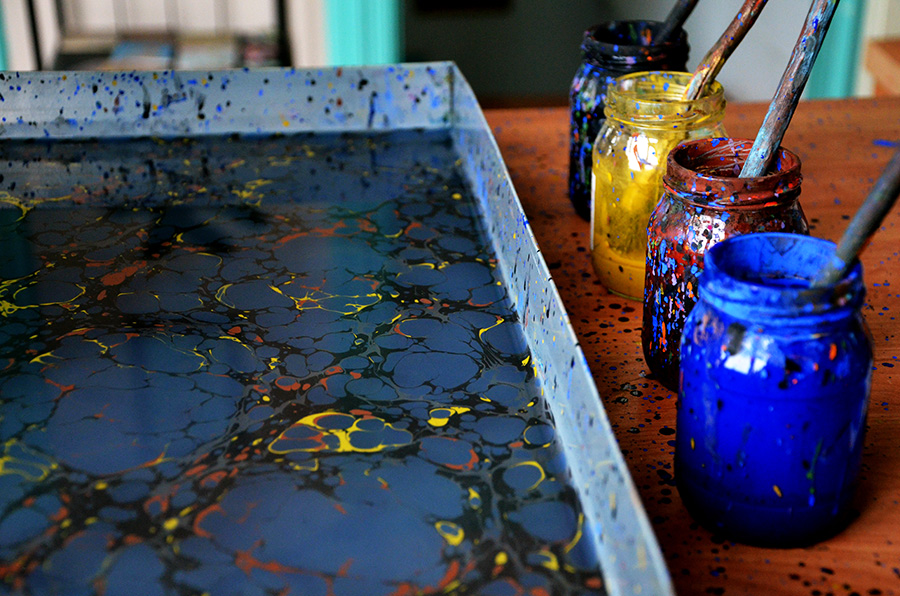
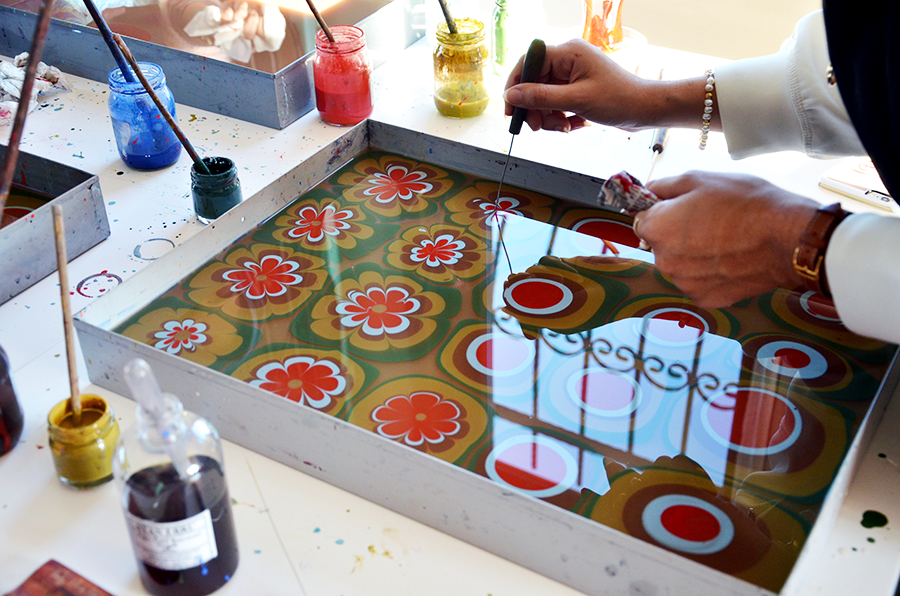
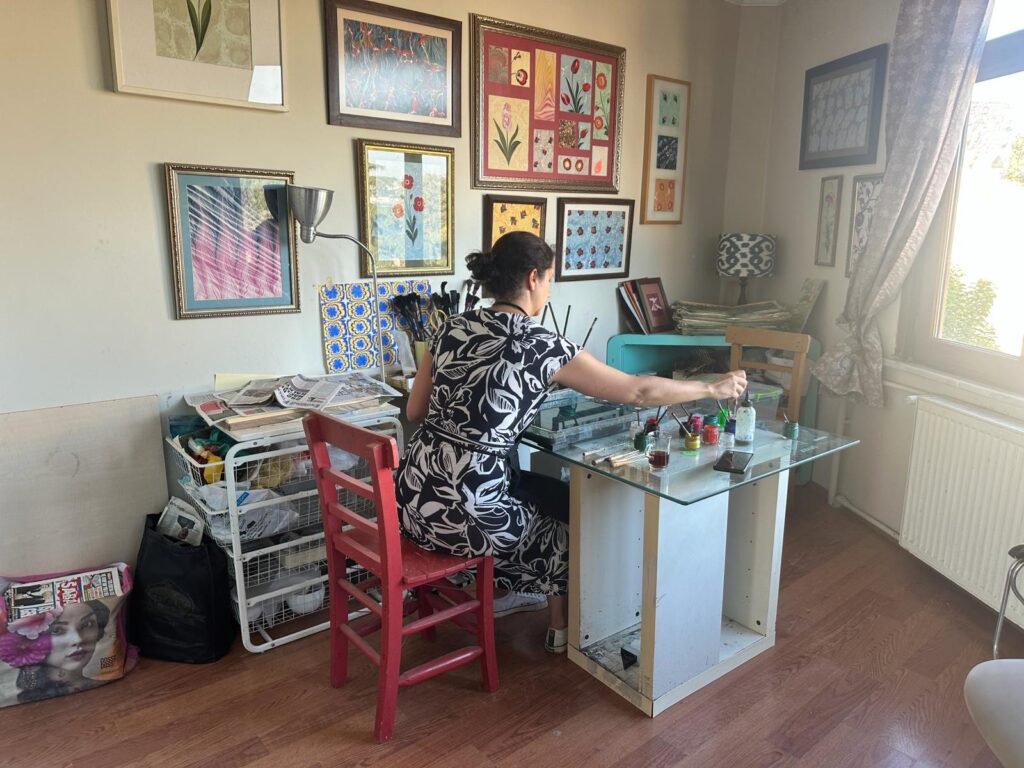
Marbling is the Art of Creating Colorful Patterns Sprinkling and brushing color pigments on a pan of oily water and then transforming this pattern to paper. The special tools of the trade are brushes of horsehair bound to straight rose twigs, a deep tray made of unknotted pinewood, natural earth pigments, cattle gall and tragacanth. It is believed to be invented in the thirteenth century Turkistan. This decorative art then spread to China, India and Persia and Anatolia. Seljuk and Ottoman calligraphers and artists used marbling to decorate books, imperial decrees, official correspondence and documents.
What is Included ;
* In Our Lessons; We Can Teach Beginner & Advanced Level Professional Artists
* Traditional Ottoman Style Paper Marbling Class.
* All Equipment for Turkish Marbling – Ebru Workshop
* Workshop Area, Aprons & Gloves
* Turkish Tea & Water and a lots of FUN : )
Additional Information ;
LEARN the Secrets of Creating the Rich Patterns of Handmade Marble Paper .
EXPERIENCE the Sensuous Flow of Ottoman Marble ( Ebru ).
CONTEMPORARY Create Design Fabric Marbling Paper Technique Designs on Paper, Glass or on Silk Fabrics .
Our teachers are local Turkish Artisans and have experience in teaching.
Our Artists are Professional in Marbling – Ebru Art & Local Artisans.
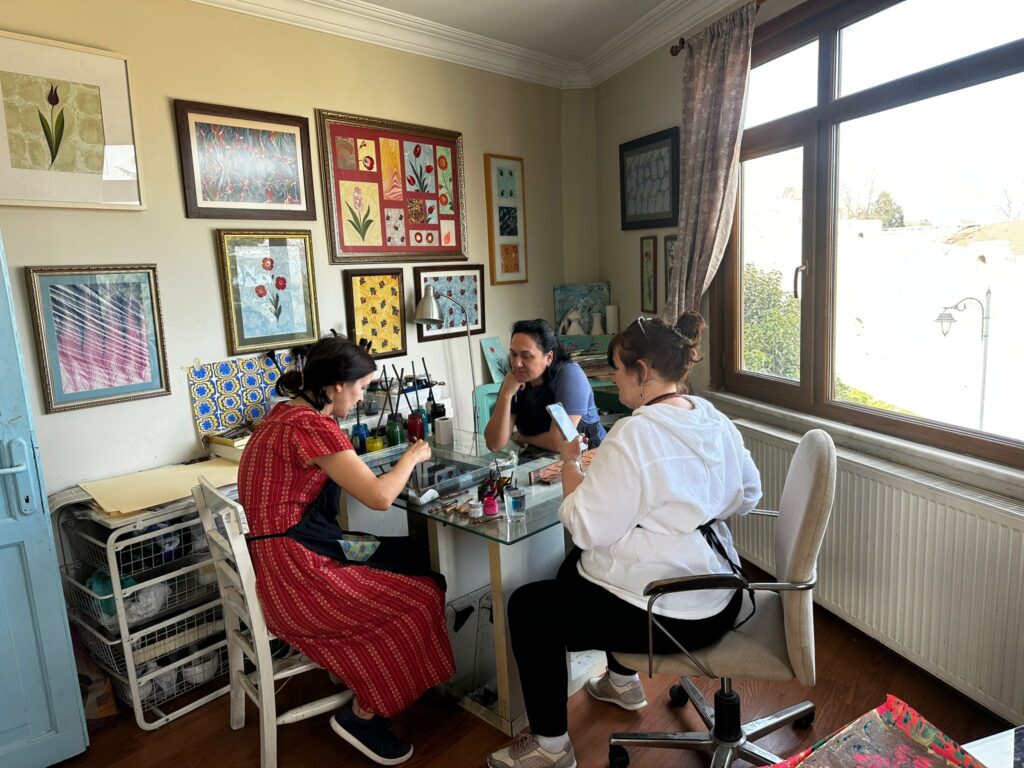
TURKISH MARBLING, EBRU LESSON IN SULTANAHMET ISTANBUL TURKIYE ;
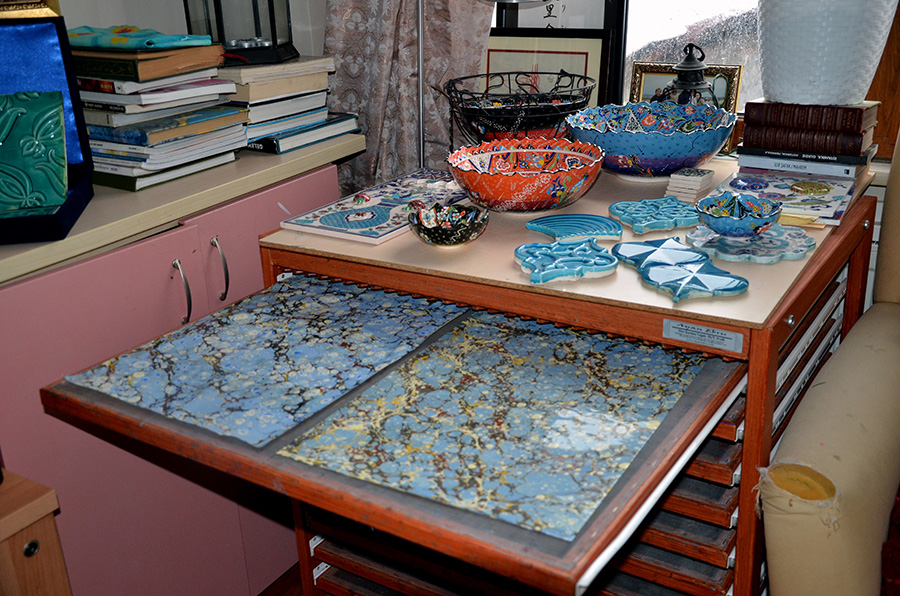
Marbled paper, called ebru in Turkish, was used extensively in the binding of books and within the calligraphic panels in Turkey. The existing word ebre in Eastern Turkish, meaning variegated, points to the fact that marbling might have been known by the populations of Central Asia. Its origin might ultimately hark back to China, where a document from the T’ang dynasty (618-907) mentions a process of coloring paper on water with five hues. In the early examples from the 16th c. in the Ottoman-Turkish era, ebru appears in the battal (stone) form, namely without any manipulation. Interestingly, several variations developed in time, giving us types such as gelgit, tarakli, hatip, bülbül yuvasi, çiçekli (respectively come-and-go, combed, preacher, nightingale’s nest, flowered, etc.) An attempt has been made here to show some of its principal patterns, with samples by the master marblers of this century chosen from our collection.
We do sell also Turkish Marbling SET and Materials ;
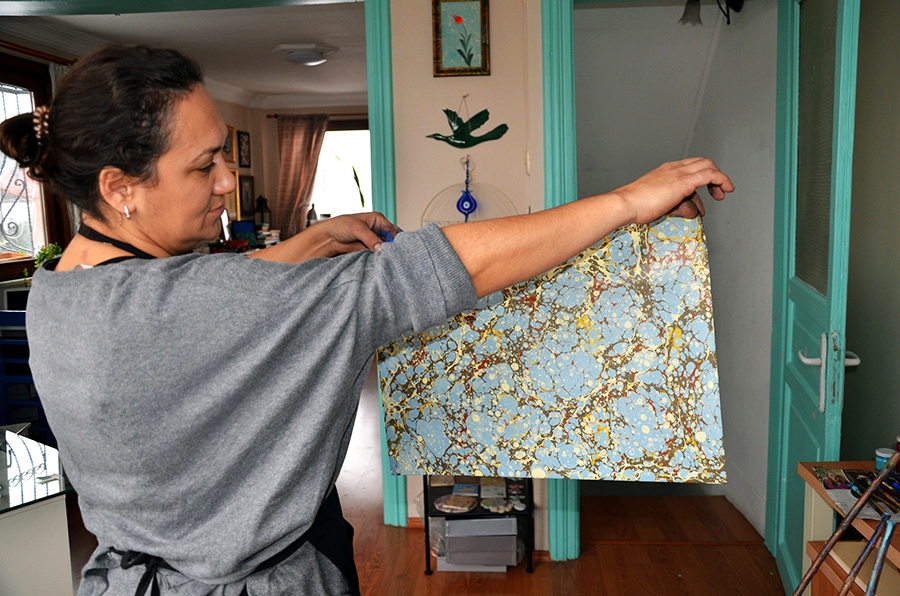
Ebru technique consists of sprinkling colours containing a few drops of ox-gall on to the surface of the bath sized with kitre (gum tragacanth) in a trough. By carefully laying the paper over the bath, the floating picture on top of it is readily transferred to the paper; thus, each ebru is a one of a kind print. To obtain beautiful ebru results, one needs to have a light hand, refined taste, and an open mind to the unexpected patterns forming on the water. Patience and a good knowledge of traditional culture are characteristic of ebru masters.
After the 1550’s, booklovers in Europe prized ebru, which came to be known as ‘Turkish papers’. Many specimens in their collections and in the several album amicorum books are visible today in various museums. Also, early texts dealing with ebru, such as “Discourse on decorating paper in the Turkish manner”, published in 1664 by Athanasius Kircher in Rome, helped to disseminate the knowledge of this kind of marbling art. There is agreement amongst scholars that the so-called Turkish Papers played a colourful influence on the book arts in Europe.
RECOMMENDED ART AND CULTURAL TOURS IN ISTANBUL ;
EBRU LESSON WORKSHOP IN SULTANAHMET ISTANBUL
TURKISH MARBLING EBRU SET AND MATERIALS ISTANBUL
TURKISH TILE PAINTING LESSON IN SULTANAHMET ISTANBUL
TURKISH HENNA LESSON IN SULTANAHMET ISTANBUL
TURKISH FELT MAKING LESSON IN SULTANAHMET ISTANBUL
CALLIGRAPHY LESSON IN ISTANBUL
HAND MADE BOOK BINDING LESSON IN SULTANAHMET ISTANBUL
TURKISH COOKING LESSON IN ISTANBUL
TURKISH MUSICAL INSTRUMENTS IN ISTANBUL
HOME MADE BAKLAVA LESSON IN ISTANBUL
Contact Name : Uğur Şengüler – Eren Tanık
Instagram : https://www.instagram.com/istanbullifeorg
Whatsapp : +905057093384 – 05421063383
E-mail : info@istanbullife.org ( 24/7 Online )
How to do Turkish Marbling?
Colored paste, made from flour and water (1:4) or other cold water paste and colored with watercolor or tempera paint, is spread onto paper and patterns are drawn with fingers, sticks, combs, or anything else at hand.
What is Turkish Water Marbling?
Ebru is the traditional Turkish art of creating colourful patterns by sprinkling and brushing colour pigments onto a pan of oily water and then transferring the patterns to paper.
How to Make Turkish Ebru?
In traditional Ebru, paint is dripped onto the surface of water and a fine brush or metal comb is used to create marbled patterns. After a pattern is created, a piece of paper is gently laid on the surface of the water. The paint adheres to the paper, creating a marbled masterpiece.
What is the Turkish Term for Paper Marbling?
The art of marbling on paper, or ‘ebru‘ in Turkish, is a traditional decorative form employing special methods. The word ‘ebru’ comes from the Persian word ‘ebr,’ meaning ‘cloud.
What does Ebru Mean in Turkish?
Ebru is the contemporary Turkish word for what is called marbled paper in English.
What is the Method of Marbling?
Paper marbling is a method of aqueous surface design, which can produce patterns similar to smooth marble or other kinds of stone. The patterns are the result of color floated on either plain water or a viscous solution known as size, and then carefully transferred to an absorbent surface, such as paper or fabric.
Can I use Acrylic Paint for Marbling?
Overall, you can use whatever paints you want to use, but if you haven’t done much marbling it tends to be helpful to use just one type of paint and not mix Heavy Body with Fluids and High Flow Acrylics.
Russian Language ;
Занятия по турецкому мраморированию – эбру в Стамбуле
Мы являемся художественной галереей и организуем мастер-классы по традиционному турецкому, османскому мраморированию – эбру в нашей художественной галерее в Султанахмете. Занятия длятся 2 часа с нашими местными профессиональными преподавателями из Университета изящных искусств Мимара Синана в Стамбуле.
Стоимость 2-х часового урока составляет : 55 EURO
Бронирование по интернету или по Whatsapp +905057093384
German Language ;
Türkisches Marmorieren – Ebru-Kurse in Istanbul
Wir sind eine Kunstgalerie und veranstalten in unserer Kunstgalerie in Sultanahmet traditionelle türkische, osmanische Marmorier- und Ebru-Workshops. Der Unterricht dauert 2 Stunden mit unseren professionellen Lehrern von der Mimar Sinan Fine Arts University in Istanbul.
Die Gebühr für 2 Stunden beträgt: 55 EURO
Buchung online oder per Whatsapp +905057093384
Arabic Language ;
انحن معرض فني وننظم ورش عمل الرخام التركي العثماني التقليدي في معرضنا الفني في السلطان أحمد. تستغرق الدروس ساعتين مع مدرسينا المحترفين المحليين من جامعة معمار سنان للفنون الجميلة في إسطنبول.
رسوم الدرس لمدة ساعتين هي: 55 دولار أمريكي.
احجز عبر الإنتالرخام التركي – دروس الرخام التركي – إيبرو في إسطنبولرنت أو عبر الواتساب 905057093384
Estonian Language ;
Türgi marmoreerimine – Ebru klassid Istanbulis
Oleme kunstigalerii ja korraldame traditsioonilisi Türgi, Ottomani marmorimise – Ebru töötubasid meie kunstigaleriis Sultanahmetis. Tunnid on 2 tundi meie kohalike professionaalsete õpetajatega Mimar Sinan Fine Arts University’st Istanbulis.
2 tunni tasu on: 55 EURO
Broneerimine Online või Whatsapp +905057093384
French Language ;
Cours de marbrure turque – Ebru à Istanbul
Nous sommes une galerie d’art et organisons des ateliers de marbrure traditionnelle turque, ottomane – Ebru dans notre galerie d’art à Sultanahmet. Les leçons durent 2 heures et sont données par nos enseignants professionnels locaux de l’Université des Beaux-Arts Mimar Sinan d’Istanbul.
Le prix d’une leçon de 2 heures est de 55 EURO
Réservation en ligne ou par Whatsapp +905057093384
Spanish Language ;
Clases de Marmoleado Turco – Ebru en Estambul
Somos una Galería de Arte y organizamos talleres de Marmoleado Tradicional Turco Otomano – Ebru en nuestra Galería de Arte en Sultanahmet. Las lecciones son de 2 horas con nuestros profesores profesionales locales de la Universidad de Bellas Artes Mimar Sinan en Estambul.
El precio de la lección de 2 horas es de : 55 EURO
Reserva en línea o por Whatsapp +905057093384
Italian Language ;
Lezioni di marmorizzazione turca – Ebru a Istanbul
Siamo una galleria d’arte e organizziamo laboratori di marmorizzazione tradizionale turca e ottomana – Ebru nella nostra galleria d’arte a Sultanahmet. Le lezioni sono di 2 ore con i nostri insegnanti professionisti locali della Mimar Sinan Fine Arts University di Istanbul.
Il costo di 2 ore di lezione è di 55 EURO
Prenotazione online o tramite Whatsapp +905057093384
Japanese Language ;
トルコマーブリング – イスタンブールでのエブル教室
私たちはアートギャラリーであり、スルタンアフメットにある私たちのアートギャラリーで、伝統的なトルコ、オスマントルコのマーブリング、エブルのワークショップを開催しています。レッスンは2時間で、イスタンブールのミマール・シナン美術大学出身のプロの講師が担当します。
2時間レッスン料金:55 EURO
ご予約はオンラインまたはWhatsapp +905057093384 まで。
Portuguese Language ;
Aulas de marmoreio turco – Ebru em Istambul
Somos uma galeria de arte e organizamos workshops de marmoreio tradicional turco e otomano – Ebru na nossa galeria de arte em Sultanahmet. As aulas são de 2 horas com os nossos professores profissionais locais da Universidade de Belas Artes Mimar Sinan em Istambul.
O preço de 2 horas de aula é: 55 EURO
Reservas online ou por Whatsapp +905057093384
Greek Language ;
Τουρκικό μαρμάρισμα – Μαθήματα Ebru στην Κωνσταντινούπολη
Είμαστε μια γκαλερί τέχνης και διοργανώνουμε παραδοσιακά τουρκικά, οθωμανικά εργαστήρια μαρμάρου – Ebru στην γκαλερί τέχνης μας στο Σουλταναχμέτ. Τα μαθήματα διαρκούν 2 ώρες με τους ντόπιους επαγγελματίες δασκάλους μας από το Πανεπιστήμιο Καλών Τεχνών Mimar Sinan στην Κωνσταντινούπολη.
Το κόστος του μαθήματος των 2 ωρών είναι : 55 EURO
Κράτηση μέσω Online ή μέσω Whatsapp +905057093384
MARBLING APPLIED TO PAPER PATTERNS
Classical Types of Ebru;
1- Battal – Stone: The oldest recorded style in Ebru. It is the base of all forms in paper marbling art. The paints stay as they drop off the brush no other effect is given.
2- Gel Git – Tidal : After having a battal base, it is formed by zigzag movements parallel to the sides of the basin. This tidal movement is sometimes applied diagonally as well.
3- Şal – Shawl : Formed by an evenly spreading of two or three ‘S’ shapes on a tidal ebru in the opposite direction of the last tidal move.
4- Bülbül Yuvası – Nightingale Nest : Formed by inside to outside spiral movements next to each other on a battal ebru.
5- Taraklı – Combed : A vertically made tidal ebru is combed in the opposite direction of the last tidal movement.
6- Kumlu – Sandy : Formed by continuously dropping of low density paint on an extremely thickened basin and letting the work sit for a long time. The surface tension is high in an extremely thickened basin. The low-density paint is going to be pressured under the high tension of the surface and after a while crack and form the sandy or bony ebru.
7- Hafif – Light : Paints are diluted more than in other ebru types. Light ebru is usually used as a base to perform calligraphy.
8- Hatip – Orator : Motifs are formed by giving movement effects to the paints that are distributed evenly within each other on the surface. Colors at the background are light, motif colors are intense.
9- Dalgalı – Wavy : When the paper is moved back and forth during the marbling, the result will appear as waves on the paper. The paper can be folded, (creases point the surface) when each move contacts with a crease it will change direction and will form the waves on the paper. Waves can be formed only if the movement has a regular rhythm.
10- Neftli Battal –Turpentine: This is obtained by sprinkling paints with some added drops of Turpentine (preferably pine turpentine) onto a ‘Battal’ background. It gives a wavy appearance.
11- Somaki Battal – Porphyry: Generally made with two color. More gall is added to the second color, which squeezes the first color and creates thin veins, like marble.
12 – Serpmeli Battal – Sprayed: After any well known “Battal marbling” is made, a second color, in contrast to the background, is sprinkled is small droplets. The paint in the brush is squeezes out carefully, and some people use a special brush for sprinkling. This sprinkling may be formed in ‘Gel-Git’ – ‘ Bülbül Yuvası’ or other patterns.
13- Ak Kase – Stenciled Marbling: This is a pattern obtained by making several imprints on the same background, and popular with calligraphers. The base consist of a ‘light marbling upon which the script is written using a special fluid prepared with gum Arabic applied with a red pen or brush. Thus the surface of the light marbling is covered (insulated) by the gum Arabic. After drying, another design using darker colors is applied on the same paper: the parts covered with gum Arabic will resist the second coat and will therefore display the script. The same technique may be applied using a stencil, and other substances can be used instead of gum Arabic, for example, heavy gum tragacanth, silicone, several transparent types of glue, etc.
14- Yazılı Ebru – Script Marbling: This is obtained by writing the script with gum Arabic and then marbling the same paper, or vice versa (Leaving the script blank and applying the gum Arabic as background). Writing with gum Arabic (Transparent ink) demands particular skill, because it is very difficult to make corrections.
Reviews
There are no reviews yet.